Preparing Your Outdoor Business For Sustainability Compliance in 2026

For the outdoor industry, sustainable business practices have moved from nice-to-have initiatives to strict legal requirements. Brands are navigating an increasingly complex system of laws across the United States, Canada, and the European Union (EU) that cover everything from greenhouse gas emissions reporting to green marketing claims.   

This blog post aims to provide a broad overview of sustainability compliance obligations for the outdoor industry, along with actions for meeting those requirements. But before we get into it, we need to start with a short disclaimer. This content is for informational purposes only and should not be construed as legal advice. Readers should consult with qualified legal counsel to ensure compliance with all applicable laws and regulations. 

Climate Accountability: Confusion in California 

California is the only state in the U.S. that has enacted climate disclosure laws. The laws mandate companies with over $500M in annual revenue to disclose their climate-related financial risk (SB 261) and mandate companies with over $1B in annual revenue to disclose their scope 1, 2, and 3 emissions (SB 253). Lawsuits challenging the constitutionality of these laws have upended the enforcement timeline. Here’s the latest:  

  • Climate-related risk reporting (SB 261): Under the original regulatory timeline, covered entities were supposed to submit their climate-related risk reports on January 1, 2026. However, the Ninth Circuit Court of Appeals granted an injunction pending appeal for SB 261, effectively pausing the enforcement of the law. Oral arguments were heard in January. Until the Ninth Circuit releases a decision following those arguments, reporting for this law is paused.  
  • Greenhouse gas emissions disclosure (SB 253): The Ninth Circuit did not grant an injunction pending appeal for SB 253. Enforcement of this law is still proceeding as scheduled, which means that covered entities should be preparing to report their scope 1 and 2 emissions in August of this year, and prepare to report their scope 1, 2, and 3 emissions in 2027. This schedule is subject to change, pending the ongoing lawsuit challenging SB 253, in addition to SB 261.  

Chemistry: PFAS Regulations Expand in Scope Across the U.S. 

Chemistry is the backbone of performance gear, providing the waterproofing and durability outdoor enthusiasts expect. However, concerns about the harm of per- and polyfluoroalkyl substances (PFAS) have led to a wave of bans and reporting requirements, including: 

  • Bans on products with intentionally added PFAS: Several states have already enacted bans on the sale of textiles and apparel containing intentionally added PFAS. 
  • Mandatory disclosure labels: Many jurisdictions require a visible label stating that products contain PFAS when on sale in retailers and online.  
  • Reporting requirements: Many states require companies to report products that have intentionally added PFAS. The U.S. government also has a one-time backward looking reporting requirement under TSCA, however, there are proposed changes to this requirement that would significantly reduce and/or eliminate reporting requirements for most outdoor companies.  

Extended Producer Responsibility (EPR): Shifting Responsibility of Products’ End-of-Life 

Governments are increasingly holding producers responsible for the waste their products and packaging create, and are turning to Extended Producer Responsibility (EPR) programs. EPR assigns producers financial or operational responsibility for the collection and recycling of their goods, which often entails: 

  • Stewardship organization enrollment: Producers can be required to join a Producer Responsibility Organization (PRO) and pay fees based on the volume and material type of their packaging.   
  • Textile recovery registration: California became the first state in the U.S. to enact a textile EPR program. Brands doing business in California will soon be required to register with a PRO and pay fees to fund the repair, sorting, and recycling infrastructure for apparel and textile articles.   
  • Eco-modulated fees: Many EPR programs are implementing “eco-modulation,” meaning fees are adjusted based on the product’s sustainable attributes.  

Green Claims: Eliminating “Greenwashing” 

Vague claims like “sustainable” or “eco-friendly” are facing global unprecedented scrutiny. Multiple U.S. states and other countries have introduced guidelines to ensure environmental marketing messaging is accurate. While laws differ, outdoor companies generally need to:   

  • Substantiate all sustainability claims: Under current federal guidelines, brands must be able to prove any environmental claim they make with reliable evidence. 
  • Adhere to state-level laws: While every state has laws prohibiting deceptive conduct, many have made “greenwashing” (the act of making false or misleading claims about the environmental benefits of a product) a violation of consumer protection laws. 
  • Disclose carbon offset processes: California now requires companies that use “net zero,” “carbon neutral,” or similar terminology to disclose on their website how those claims are achieved (CA AB 1305). 

Ensure Your Outdoor Brand is Compliant in 2026 

As new laws take effect, OIA is here to help outdoor companies implement sustainable business practices and remain compliant. We recently released an updated version of our “Guide to Comply” exclusively for OIA members. This 20+ page resource covers the specific regulations impacting the outdoor industry in 2026. 

In addition to this guide, our Support Plus and Leadership members get access to our Sustainability Policy and Reporting Task Forces. These groups provide time-sensitive alerts as new legislation emerges and a place to discuss compliance challenges with peers.  

If you’re ready to learn more about the benefits of becoming an OIA member, get in touch with us.  

References: 

https://ww2.arb.ca.gov/our-work/programs/california-corporate-greenhouse-gas-ghg-reporting-and-climate-related-financial 

https://www.whitecase.com/insight-alert/california-climate-disclosure-laws-ninth-circuit-hears-oral-argument-no-ruling-yet 

https://calrecycle.ca.gov/epr/textiles/ 

https://www.persefoni.com/blog/ab-1305 

https://leginfo.legislature.ca.gov/faces/billTextClient.xhtml?bill_id=202320240AB1305

The Hidden Challenge of Circularity: Managing Chemical Risks in Recycled Materials

recycled-materials-challenges

Recycling is a cornerstone of the circular economy, aiming to reuse products and regenerate materials to reduce environmental impacts like greenhouse gas emissions. However, as outdoor companies expand their commitments to using recycled content, a significant challenge has emerged: chemical safety. 

Today’s recycling systems are not fully equipped to guarantee that recycled feedstocks are free from hazardous substances. Without strong safeguards, brands and manufacturers risk unintentionally recirculating “legacy” chemicals into their products or even introducing new contaminants caused by the recycling process itself.  

Understanding the Infrastructure Gap 

Recycling capabilities vary wildly across plastics, textiles, paper, and metals. Most current systems are optimized for clean, single-material streams, but real-world waste is often highly mixed and chemically complex. 

In general, there are two common recycling processes that each pose different chemical risks: 

  • Mechanical Recycling: Dominates the market but tends to recirculate rather than remove chemicals, leaving new products vulnerable to contamination. 
  • Molecular (Chemical) Recycling: Can remove unwanted substances, but requires more energy and may result in chemicals of concern released into the environment surrounding the recycling facility.  

Critical Risk Areas for the Outdoor Industry 

For our industry, textiles represent the most critical risk area. Currently, less than 1% of collected textiles are recycled back into new fibers, but those that are often come from sources with unknown chemical histories. 

Factors like limited ingredient transparency and multi-material construction increase the likelihood that restricted substances, such as PFAS, phthalates, heavy metals, and flame retardants, make it into the final product. These risks extend to other materials as well: 

  • Plastics: Often contain non-intentionally added substances (NIAS) and residual chemicals. 
  • Metals: Can inadvertently introduce toxic heavy metals if waste streams are poorly characterized. 
  • Paper: Requires careful management to avoid contaminants found in original coatings and inks. 

A Path Toward Non-Toxic Circularity 

There is currently no comprehensive, affordable testing protocol that can reliably identify every contaminant in every batch of recycled feedstock. And while certifications help manage risk, they do not completely eliminate it. Rather, success depends on rigorous implementation and total supply-chain transparency. 

To move forward, outdoor companies must adopt a systems-level approach to chemical risk. This includes: 

  • Evaluating the origin of feedstocks and sorting processes. 

  • Assessing contamination risks specific to material types. 

  • Collaborating across industry, academia, and policy to develop safer chemistries and better traceability. 

Learn About Chemical Safety with OIA’s New Guidebook 

The Outdoor Industry Association (OIA) has developed a comprehensive “Chemical Risks of Recycled Materials Guidebook” to equip outdoor companies with the tools and insights needed to safely source recycled materials. It outlines risks by material category, compares recycling technologies, and provides a practical framework for evaluating suppliers and assessing contamination risk based on four key categories: 

  • Original material use, application, and industry.
  • Collection, sorting, and other pre-processing methods.
  • Recycling methods and quality control specifications.
  • End-use application. 

The guidebook is currently available in the OIA Mobilize platform. Not an OIA Support Plus or Leadership member but want to learn more? Get in touch today. 

REI Co-op, Carhartt, ERM Coho, and OIA Announce Collaborative Renewable Energy Project

REI Co-op, Carhartt, ERM Coho, and Outdoor Industry Association (OIA) announced their participation in a collaborative solar project. The solar project, Misae II, developed by Greenalia, is located in Texas and will begin delivering renewable energy certificates to REI Co-op and Carhartt in 2026.

The collaborative solar project, accessed via a Virtual Power Purchase Agreement (VPPA), was offered through OIA’s Climate Action Corps Impact CoLab, in partnership with member brands and ERM Coho. OIA’s Impact CoLabs accelerate industry progress by enabling brands and suppliers to work together, meeting company sustainability goals more efficiently and cost-effectively. Learn more about Impact CoLabs here.

“We’re excited by how this VPPA will support our longstanding commitment to 100% renewable energy. This is our largest solar project (yet) in a state where we have a strong presence with 11 stores. Partnering with others in the outdoor industry on this project demonstrates how collaboration is critical to accelerating the decarbonization of our grids and protecting everyone’s right to a healthy outdoors,” said Jay Creech, manager of net zero for REI Co-op.

A VPPA is a financial contract for differences between a buyer (or group of buyers) and a large-scale renewable energy project, in which the buyer commits to a fixed price and receives the floating wholesale electricity price.  Companies that are unable to install onsite solar to meet 100% of their energy demand can use VPPAs to procure offsite renewable energy. VPPAs are typically only available to very large energy buyers. Smaller companies can access VPPAs by working together, and industry associations like OIA provide a platform to enable that collaboration.

“This agreement demonstrates the success that results from buyers and developers being collaborative. When companies unite as a structured buyer group, they unlock access to large-scale clean energy solutions and strengthen decision-making,”  said Chris O’Brien, Partner, Vice President Business Development for ERM Coho.

Key Outcomes of the VPPA CoLab:

  • Renewable Energy: The VPPA supports 18.5 megawatts of renewable energy.
  • Collective Impact: Individually, OIA members would not have met the electricity supply required to participate in a VPPA. By coming together through OIA to aggregate their energy demand, members were able to execute a joint VPPA.
  • Building Knowledge: Members gained a strong understanding of the complex VPPA market through the CoLab. The collaborative process demystified renewable energy procurement and equipped members with the tools to execute a clean energy deal.
  • Driving New Construction: The CoLab enabled the construction of a new utility-scale solar project in Texas, bringing additional clean energy onto the grid.
  • Verified Impact: CoLab participants receive Renewable Energy Certificates (RECs), allowing them to reduce their emissions.

“The path to a better future is paved through collaboration and partnership,” said Gretchen Valade, Director, Sustainability, Carhartt, Inc. “No single organization can tackle the complexities of decarbonization alone, but together, we can drive meaningful progress. We are proud to be a part of this important effort to support renewable energy generation and build a more sustainable world.”

“We are incredibly proud of the successful collaboration among the VPPA CoLab participants, culminating in a renewable energy project that will deliver long-term clean energy benefits and advance the outdoor industry’s collective climate goals. This project stands as a powerful testament to the impact we can achieve when we unite our efforts and provides a replicable model for others in the industry,” said Julie Brown, Director of Sustainable Business Innovation at OIA.

About Outdoor Industry Association

Based in Boulder, Colo., with offices in Washington, D.C., Outdoor Industry Association (OIA) is a catalyst for meaningful change. A member-based collective, OIA is a passionate group of business leaders, climate experts, policy makers, and outdoor enthusiasts committed to sustainable economic growth while protecting – and growing access to – the benefits of the outdoors for everyone. For more than 30 years, OIA has catalyzed a thriving outdoor industry by supporting the success of every member company across four critically aligned areas: market research, sustainability, government affairs, and inclusive participation. OIA delivers success for its members through education, events, and business services in the form of solutions and strategies, consultation, collaboration, and opportunities for collective action. For more information, visit outdoorindustry.org.

About Carhartt

Established in 1889, Carhartt is a global premium workwear brand with a rich heritage of developing durable products for workers on and off the job. Headquartered in Dearborn, Mich., with more than 3,000 employees worldwide, Carhartt is family-owned and managed by the descendants of the company’s founder, Hamilton Carhartt.

About ERM Coho

ERM Coho is a global climate adviser dedicated to helping clients navigate complexity and take ambitious steps on their climate journey. We provide deep market insight, analytical problem-solving, and change management expertise so that clients can switch to renewable energy and make other large-scale climate and water resiliency investments with confidence and internal alignment. To learn more about how ERM Coho can help organizations get ahead of their climate goals, visit www.cohoclimate.com.

About Greenalia

Greenalia S.A. is a global IPP focused on renewable energy. The company uses wind, sun, and forestry biomass from certified plantation residues to generate and store energy in harmony with nature, providing employment and innovation in Europe and the US. The company’s main activity is the generation of renewable energy, being present in six technologies: onshore wind, offshore wind, solar, biomass, storage, hydrogen, and carbon capture.

About REI Co-op

REI is a specialty outdoor retailer, headquartered near Seattle. The nation’s largest consumer co-op, REI, is a growing community of 25 million members who expect and love the best quality gear and outstanding customer service. In addition to the co-op’s many stores across the country, outdoor enthusiasts can shop at REI.comREI Outlet, or the REI shopping app. Everyone is welcome to shop at REI, but members who join the co-op enjoy a range of benefits. REI is a purpose-driven and values-led company dedicated to enabling life outside for all.

Your Guide to Sourcing More Sustainable Aluminum

Introducing OIA’s Aluminum Guidebook

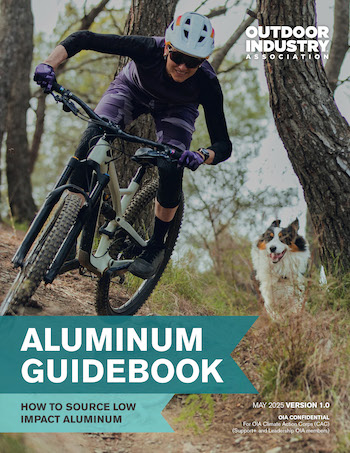
Aluminum is one of the most widely used materials in the outdoor industry, valued for its strength, lightweight properties, affordability, and availability. However, it is also a significant contributor to many brands’ environmental footprints. In response to OIA members seeking guidance on reducing their aluminum-related greenhouse gas (GHG) emissions, we created the Aluminum Guidebook. While aluminum is a common material in outdoor products, the industry lacks clear guidance on practical environmental impact strategies for this material. The guidebook fills that gap by outlining actionable pathways to lower the environmental impact of aluminum without compromising product performance. 

“The production of aluminum in our supply chain is one of the biggest sources of carbon emissions.  The industry and SRAM have made progress, but we have a lot of work left to do. Creating this guidebook was a great opportunity to share our experience, learn from others on this journey, and will help SRAM formalize our work and educate our teams on how we can adopt more low-carbon aluminum,” said Nick Myhre, Sustainability and Strategy with SRAM. 

Aluminum Guidebook Purpose 

The Aluminum Guidebook helps sustainability, sourcing, materials, and product teams in outdoor companies of any size integrate more environmentally friendly aluminum into their products.   

Co-created by OIA’s Aluminum Task Force, made up of brands across categories such as camp, cycling, ski and snow, footwear, drinkware, and accessories, the guide brings together resources from brand leaders, aluminum organizations (e.g., Aluminum Stewardship Initiative, International Aluminum Institute), and learnings from direct conversations and site visits with manufacturing partners. These members worked to build a comprehensive guidebook for all outdoor brands to reduce their emissions.

We encourage members to use the guidebook to establish internal processes for sourcing low-impact aluminum and to engage their supply chain partners in driving real, measurable progress together. The guidebook is designed to help sustainability and supply chain teams build stronger internal alignment by creating a shared language and an understanding of why low-carbon aluminum matters and how to source it. 

OIA acknowledges that aluminum production also presents other sustainability challenges, including ecosystem disturbances, air and groundwater pollution, and water consumption. While these issues are important, the guidebook centers specifically on reducing GHG emissions.   

“As a mid-sized brand, Peak Design is very familiar with the challenges of sourcing low-carbon aluminum and the complexities of the aluminum supply chain. For over six years, Peak Design has been expanding our use of lower-impact aluminum, but it became clear that we couldn’t fully succeed alone. By engaging with OIA, we’ve helped align brands around a shared understanding of the challenges and built a unified, actionable, recommended approach to low-carbon sourcing. The guidebook bridges common disconnects between sourcing, sustainability, and leadership teams and offers a clear framework for decision-making. This work directly supports our own goals while helping raise the bar for the outdoor industry. There is a long way to go, but we have a clearer roadmap than ever before,” said Oliver Ambros, Supply Chain Sustainability Manager at Peak Design.  

Guidebook Key Points:   

  • Low-impact aluminum = aluminum produced with a lower carbon footprint 
  • There are two main ways to reduce carbon emissions in aluminum production: 
    • Low-carbon energy, such as hydro or other renewable power sources 
    • Recycled content materials, either pre or post-consumer 
  • Lower emissions ≠ worse performance 
  • Strong relationships with internal teams and supply chain partners are critical for increased impact.   

Lower Emissions ≠ Worse Performance 

Low-impact aluminum (produced using recycled content and/or low-carbon energy sources) is a key driver for reducing greenhouse gas emissions and meeting climate targets. Shifting to low-impact aluminum does not mean sacrificing product performance. While the outdoor industry represents a small share of global aluminum demand, collaboration across our industry can help build a stronger, collective voice to advocate for low-carbon options.  

Strong Relationships are Key to Impact 

Building strong relationships is essential for impact—internally with product and design teams to align performance and sustainability goals, and across the value chain to better understand sourcing challenges and opportunities. Together, we can help accelerate the shift toward low-impact aluminum and a more sustainable industry. 

Resources to Support Your Low-Impact Aluminum Journey 

  • Join OIA to gain full access to the Aluminum Guidebook  

“OIA members created the Aluminum Guidebook to help our industry tackle a shared challenge: driving meaningful emissions reductions in a complex and competitive aluminum supply chain. It can be difficult for individual brands to influence suppliers, especially when competing with larger industries like automotive or aerospace, but when our members come together, they become a powerful collective voice for change. This guidebook is a tool to harness that strength and support coordinated, actionable progress across the industry,” said Julie Brown, OIA Sustainable Business Innovation Director.  

Our Collective 2024 Climate and Clean Chemistry Impact

OIA Members Make Significant Progress in 2024

In 2024, 84 OIA members participated in the Climate Action Corps (CAC) and/or the Clean Chemistry and Materials Coalition (CCMC). These programs are designed to support outdoor companies in reducing their impacts on the planet. Companies of different sizes, product categories, and geographic locations came together with the goal of working together to leave our planet better than we found it and to protect the outdoor experience upon which we all depend. Each program has a pathway for reducing impacts and achieving programmatic goals (learn more about our programs here). This blog takes a deeper dive into the member stories and successes from 2024.  


Climate Action Corps 2024 Progress: Five Years of Impact Throughout the Value Chain 

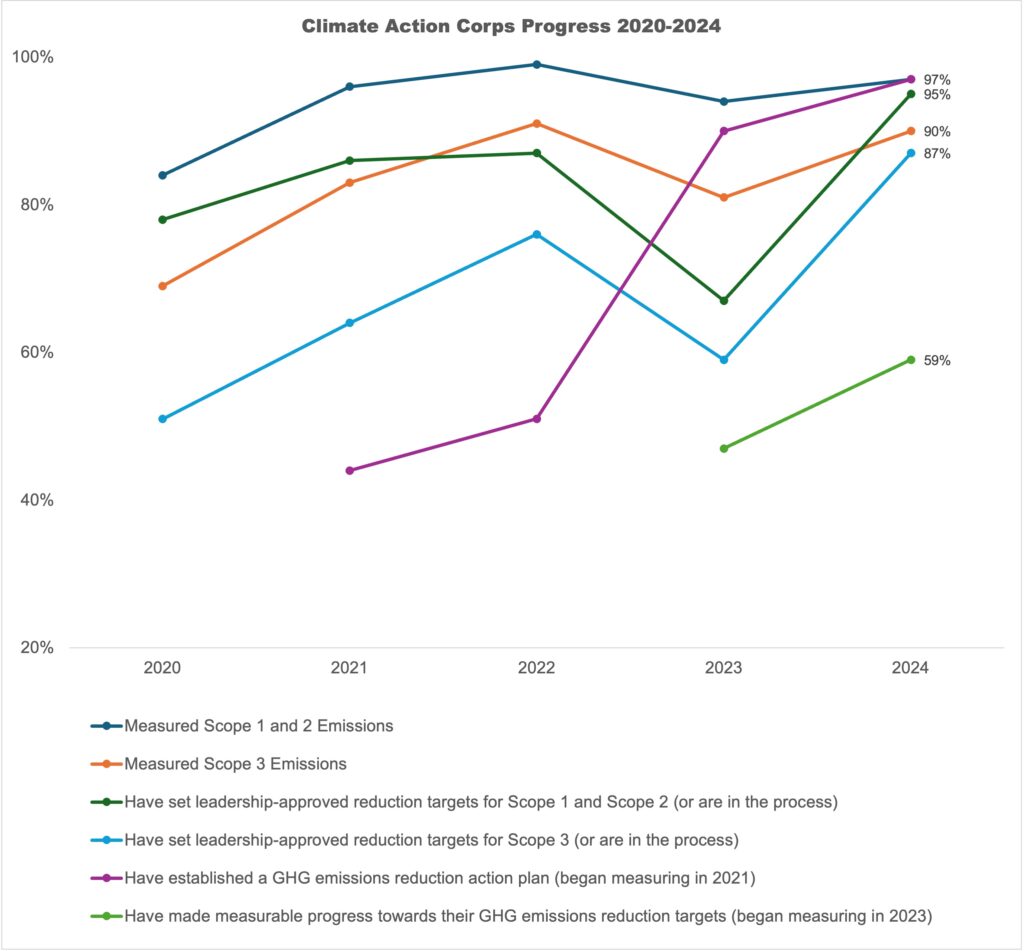
In the fifth year of tracking member progress, the CAC continues to make great progress along the pathway of measuring greenhouse gas (GHG) emissions, setting GHG emission reduction targets, and making GHG reductions across emission scopes. Compared to 2023, CAC members increased their progress on average by 15% across all major tracked categories. Here is a snapshot of the cumulative progress CAC members have made (note – there are some data discrepancies that account for inflated percentages in 2021 and 2022 that were remedied in 2023 and going forward): 
Here is the progress that CAC members made in 2024: 

  • 97% have measured their company’s Scope 1 and Scope 2 emissions (or are in progress or have an initial estimate) 
    • Scope 1 emissions are a company’s direct emissions from owned or controlled sources. Examples of these include combustion of fuels, fugitive emissions, etc. 
    • Scope 2 emissions are indirect emissions from a company’s purchased energy generated off-site. The main example is electricity.                   
  • 90% have measured their company’s Scope 3 emissions (or are in progress or have an initial estimate) 
    • Scope 3 emissions are a company’s indirect emissions that occur in the value chain, including both upstream and downstream emissions. Examples of these include purchased goods & services, third-party logistics, business travel, etc.  
  • 95% have set leadership-approved reduction targets for Scope 1 and Scope 2 (or are in the process) 
  • 87% have set leadership-approved reduction targets for Scope 3 (or are in the process) 
  • 97% have established a GHG emissions reduction action plan (or are in the process) that guides efforts to achieve their targets 
  • 59% have made measurable progress towards their GHG emissions reduction targets 


Going Beyond the Numbers 

REI’s total 2024 emissions (Scopes 1, 2 and 3) were 12.2% lower than emissions in their 2019 baseline year. They achieved this reduction through: 

  • 100% renewable energy 
  • Lower-carbon materials 
  • Reducing emissions from REI Co-op product manufacturing 
  • Engaging retail brand partners to reduce emissions 
  • Reduced emissions from international freight 
  • Expanding clean energy procurement resources with manufacturing partners 
  • Providing expertise, knowledge, and tools to accelerate supplier decarbonization 
  • Investing in Southeast Asia’s clean energy ecosystem 

In 2024, Klean Kanteen’s scope 1 and 2 emissions were 74% below their base year level in 2016 and scope 3 emissions were 86% below their base year level in 2019. Some actions Klean took to reduce their emissions include:  

  • Produced or procured renewable electricity (and/or renewable energy credits) for their owned/controlled facilities 
  • Engaged with their suppliers about energy efficiency 
  • Engaged their suppliers about measuring their GHG emissions 
  • Changed their company’s products and materials to alternatives with lower-GHG footprint 

L.L.Bean achieved a 22% absolute reduction in scope 1 and 2 emissions from 2019 to 2024. They decreased their scope 1 emissions significantly by investing in a new headquarters and electrifying their primary heat source, which was previously natural gas. In addition, L.L.Bean has made energy-efficient investments resulting in an overall decrease in Scope 2 emissions across stores, their fulfillment center, and HQ. Examples include switching to energy efficient lighting, compressors, and HVAC units.  Warmer winters and the increase of renewable energy in the New England power grid have also supported their Scope 2 reduction. L.L.Bean plans to retire Renewable Energy Certificates to reach the overall 50% reduction by the end of 2025, through their participation in 16 renewable energy projects across Maine.    

Rab USA’s 2024 carbon accounting data showed a 47% reduction in total emissions from a 2019 baseline. This reduction includes a 66% reduction in purchased goods and services in their scope 3 emissions through collaborating with their supply chain. Rab’s overall emissions have fallen due to three significant changes in the last year:    

  • Adoption of renewable energy in tier 1 suppliers 
  • Reduction in production figures due to a focus on reducing stock levels within their supply chain.   
  • Switching to primary production data rather than secondary data to improve their raw materials’ GHG emissions calculator methodology  

We look forward to supporting our members’ progress to make greater, measurable reductions in GHG emissions, despite external economic and regulatory pressures facing the industry and our supply chains.

See Climate Action Corps members’ individual 2024 progress here.  


Clean Chemistry and Materials Coalition 2024 Progress: Members Show Leadership in Inaugural Reports 

 2024 was the first year OIA asked members of the Clean Chemistry and Materials Coalition (CCMC) to report on their progress. In the inaugural progress reports, CCMC members showed company commitments to cleaner, safer chemistry. Since the inception of CCMC in Summer 2023, the outdoor industry has come together to phase out per- and polyfluoroalkyl substances (PFAS), champion safer chemistry in the supply chain, and switch to safer chemical and material alternatives when possible. Creating a robust chemicals management system is a long and complex process, but CCMC members have already achieved the following:  

  • 80% have set goals related to chemicals management 
  • 67% have an action plan that guides efforts to achieve their chemicals management goal(s) 
  • 92% have communicated their RSL to finished goods suppliers, representing 95% or more of their production volume   
    • RSL = Restricted Substances List     
  • 71% have communicated their RSL to materials suppliers, representing 95% or more of their production volume 
  • 57% have engaged with many finished goods suppliers about implementing a chemicals management system 
  • 41% have engaged with many materials suppliers about implementing a chemicals management system 


Going Beyond the Numbers 

Cotopaxi, through a strategic approach to material sourcing and internal due diligence testing, is confident that as of 2024, its products contain no intentionally added PFAS. However, Cotopaxi recognizes that current PFAS testing methodologies have yet to fully align with evolving regulatory standards, and they continue to assess and refine their verification processes to ensure the highest level of accuracy.  

VF Corporation, the parent company of CCMC members Altra, Smartwool, Timberland, and The North Face, has a robust, proprietary chemicals management program called CHEM-IQ. Through this program, VF has committed to eliminating and/or restricting 100% of unwanted chemicals or substances from VF’s supply chain by FY26. Through CHEM-IQSM, VF has identified and removed more than 1,330 MT of non-preferred chemicals from its supply chain. In FY2024, 420+ supply chain factories participated in the CHEM-IQ program. 

YETI has an extensive restricted substances list (RSL) that provides clear and concise guidance to enable responsible product development and chemical management within its supply chain. Their RSL specifies the chemical restrictions applicable to substances used in manufacturing YETI components, products, and packaging. In addition, it outlines the responsibilities of suppliers to YETI and identifies resources available for support. YETI has also phased out long-chain PFAS and its derivatives, bisphenols and their derivatives, and was on track in 2024 to phase out short-chain PFAS and their derivatives, and PVC (excluding promotional stickers, window decals, and select international accessories). 

See Clean Chemistry and Materials Coalition members’ individual 2024 progress here. 


How OIA Helped Members Achieve Their Goals in 2024 

In 2024, the OIA Sustainable Business Innovation team expanded our resources and collaboration offerings for our members to help them achieve their goals in climate and chemistry. We introduced task forces in the spring to give members the opportunity to collaborate on a climate or chemistry topic, without any additional financial investment. These task forces addressed issues like PFAS testing, sourcing low-impact aluminum, tracking sustainability regulations, and more. Our past and current task forces include: 

  • Hardgoods Task Force: developed a resource for all OIA sustainability members, outlining potential chemical contamination hotspots in hardgoods. 
  • PFAS Testing Task Force: investigated which materials were most likely unintentionally contaminated with PFAS. An executive summary of those findings is available to all OIA members. 
  • Aluminum Task Force (ongoing): guidebook to source low-carbon aluminum 
  • Content Claims Standards Task Force (ongoing): Creating a guidebook to support finished goods manufacturers with Textile Exchange’s Content Claim Standard implementation. 
  • Chemical Risks for Recycled Materials Task Force (ongoing): creating a guidebook to understand the risks of chemical contamination from recycled feedstocks.  
  • Compliance Reporting Task Force (ongoing): supporting members with state and federal reporting requirements throughout the year. 
  • Supplier Climate Principles Task Force (ongoing): creating a collective approach for engaging with suppliers to reduce emissions. 
  • Sustainability Policy Task Force (ongoing): supporting sustainability compliance and advocacy at the state, federal, and international levels. 

We also continued our Impact CoLabs in 2024 – collaborative, pre-competitive, emissions reduction initiatives led by OIA and service providers to help members meet their sustainability goals more efficiently through collaboration. Learn more about Impact CoLabs here. Here are the CoLabs we offered members in 2024:  

  • Clean Heat: decision support tool to electrify heating in textile facilities 
  • Virtual Power Purchase Agreement: group procurement of renewable energy  
  • Drinkware: carbon reduction roadmaps for drinkware manufacturers  
  • Tent Flammability: change policy to no longer require dangerous flame retardants in tents 

The OIA Team also released additional resources in climate and chemistry, and advocated on behalf of our industry in Vermont, Colorado, Maine, Washington, and California (PFAS and Climate). We held 12 webinars, 12 Campfire Chats (member-led discussions on a sustainability topic), and 24 technical and legislative office hours for our members. Finally, we held our inaugural Catalyst Conference in Seattle, WA, and gathered 175 outdoor industry professionals in person for the first outdoor sustainability-centered event since 2019. At this conference, sustainability practitioners of all levels discussed GHG reduction, green marketing strategies, chemicals management, and more. We were thrilled to gather with our community and tackle important issues in climate and chemistry together.  

We are incredibly proud of our members’ progress in 2024 and look forward to the continued trend of positive progress from our industry in climate action and safer chemistry. The trail to a more sustainable future can be bumpy, but with the collective force of the outdoor industry, we can lead in creating a more sustainable future.  Join us.

 Data Disclaimer: OIA does not verify member progress report claims. Members report on their own progress, and give OIA permission to share publicly. Some GHG reductions reported may be the result of a decline in business, or other externalities that caused a drop in emissions unrelated to specific member reduction actions. 

 

A Smarter Path to Cleaner, Safer Products: OIA’s Six-Step Roadmap for Chemicals Management

The outdoor industry thrives on innovation, performance, and a commitment to sustainability. Yet, as awareness of the environmental impact of business grows, companies are facing increasing pressure to align their products and supply chains with sustainable practices that prioritize safety and transparency. 

Chemicals used in outdoor recreation products—from waterproof coatings to durable textiles —play a critical role in performance. However, many traditional formulations contain substances that pose risks to human health and ecosystems. Governments worldwide are implementing stricter regulations, and consumers are demanding greater accountability from brands. 

Recognizing this shifting landscape, the Outdoor Industry Association (OIA), through its Clean Chemistry and Materials Coalition (CCMC), is equipping outdoor businesses like yours with the tools and strategies you need to take proactive steps toward safer, cleaner product development. 

New OIA Resources: A Roadmap for Safer Products 

To help organizations navigate chemical safety, compliance, and innovation, OIA is releasing two new resources to guide planning and implementation to reach sustainability goals.  

  • CCMC Guidebook – A comprehensive, 73-page resource for Support+ and Leadership members, featuring detailed checklists, case studies, and technical guidance on building a robust chemicals management program. 

Both guides center around OIA’s six-step CCMC Pathway, which provides you with a structured approach to eliminating harmful chemicals, adopting safer alternatives, and integrating supply chain sustainability into long-term strategies. 

Let’s explore these six steps and how your company can leverage them to build a safer, more sustainable business. 

1. Discover: Map Your Chemistry Footprint

Before businesses can improve chemical safety, they need to understand their starting point. The first step in chemicals management is gaining visibility into your supply chain, materials, and potential chemical hazards. 

Key actions: 

  • Map your supplier network – Understand where and how your products are made, including Tier 1 and upstream suppliers. 
  • Build a material inventory – Track what’s in your products, from base materials to performance treatments. 
  • Identify high-risk chemicals – Review industry-standard Restricted Substances Lists (RSLs) and emerging regulations, such as PFAS bans. 
  • Monitor evolving regulations – Stay ahead of national and international compliance requirements to avoid risks like product recalls. 

Why this matters: Businesses that take a proactive approach to understanding their chemical footprint will reduce regulatory risks and build consumer trust. 

2. Plan: Set Goals and Build a Strategy

Once a company understands its chemical risks, the next step is to set clear objectives and create an action plan for safer chemistry. 

Key actions: 

  • Define internal and external goals – Set measurable targets for eliminating harmful chemicals and adopting safer alternatives. 
  • Assign responsible teams – Ensure cross-functional collaboration across product development, compliance, and sourcing teams. 
  • Develop a phased action plan – Outline short-term compliance goals and long-term innovation strategies. 
  • Ensure supplier accountability – Work with manufacturers to implement clear, enforceable chemical policies. 

Why this matters: A strategic plan keeps businesses on track, ensuring chemicals management efforts align with business sustainability goals. 

3. Act: Implement Safer Practices

With a plan in place, companies must now take action to integrate safer chemistry into product development and supply chain management. 

Key actions: 

  • Adopt a Restricted Substances List (RSL) – Align with industry standards to ensure compliance across product lines. 
  • Implement a robust testing program – Establish procedures for monitoring chemicals at various stages of production. 
  • Communicate expectations with suppliers – Clearly define what materials and formulations are acceptable. 
  • Phase out high-risk chemicals – Proactively replace harmful substances with verified safer alternatives. 

Why this matters: Companies that act now to implement safer chemicals management will be better positioned for future regulations and market demands. 

4. Accelerate: Strengthen Supplier Partnerships & Drive Innovation

Once the foundation of a chemicals management program is in place, the next step is to scale impact through continuous improvement and innovation. 

Key actions: 

  • Move beyond compliance – Establish Manufacturing Restricted Substances Lists (MRSLs) to control chemical inputs, not just finished products. 
  • Implement supplier chemicals management systems – Work directly with manufacturers to improve chemical safety practices. 
  • Explore green chemistry innovations – Invest in safer material alternatives that enhance product durability and performance. 
  • Leverage data-driven decision-making – Use testing insights and supplier audits to refine chemical safety strategies. 

Why this matters: Forward-thinking organizations go beyond compliance—they lead with innovation and corporate environmental responsibility. 

5. Advocate: Shape the Future of Safer Chemistry

The outdoor industry must work collaboratively to drive systemic change. Businesses that engage in policy advocacy and industry partnerships can help shape a greener future for outdoor products. 

Key actions: 

  • Support public policies that promote safer alternatives and sustainability in business. 
  • Engage with policymakers to influence chemical safety regulations. 
  • Collaborate with industry groups – Join coalitions like OIA’s CCMC to share best practices and research. 
  • Invest in sustainable chemistry startups to accelerate eco-friendly business solutions. 

Why this matters: Companies that take an active role in shaping the future of chemicals management will help set industry standards, rather than simply reacting to them.

6. Share: Build Trust Through Transparency

Consumers expect companies to be honest and transparent about their sustainability efforts. Clear communication about chemicals management builds credibility and loyalty. 

Key actions: 

  • Provide verifiable data – Back up environmental claims with testing results and certifications. 
  • Educate consumers – Help customers understand why safer chemistry matters and how it enhances product performance. 
  • Avoid misleading green claims – Ensure all sustainability messaging is accurate and compliant with greenwashing laws. 
  • Report progress publicly – Share chemicals management milestones in sustainability reports and marketing materials. 

Why this matters: Transparent organizations build stronger consumer relationships while staying ahead of corporate sustainability regulations. 

Taking the First Step Toward Safer, Smarter Products 

Adopting robust chemicals management practices is no longer optional — it’s a business imperative. Companies that fail to act risk regulatory penalties, supply chain disruptions, and consumer backlash. 

By following OIA’s six-step roadmap, your company can: 

  • Reduce regulatory risk and stay ahead of evolving laws. 
  • Enhance brand trust through credible sustainability efforts. 
  • Leverage sustainable innovation to create high-performance, low-impact products. 
  • Strengthen supplier relationships for a resilient, responsible supply chain. 

The Clean Chemistry and Materials Coalition (CCMC) is here to help. Whether you’re just getting started or refining an existing program, OIA’s new Chemicals Management Getting Started Guide and CCMC Guidebook provide the tools and resources you need. 

Learn more and access the resources at outdoorindustry.org. 


How Outdoor Brands Are Reducing Textile Emissions with Smarter Energy Solutions

Reducing emissions in textile production isn’t just an environmental responsibility—it’s a business necessity. Consumers expect brands to take meaningful action on sustainability, and regulations are pushing companies to reduce their carbon footprints. One of the biggest challenges? The fossil fuel-based heating systems used in textile manufacturing. 

Traditional heating methods rely on coal, gas, or oil, making them a major source of greenhouse gas emissions. The textile and apparel industry alone contributes about 2% of global emissions, and with demand increasing, that number will only grow. If your brand is committed to lowering emissions, tackling the energy sources used in textile mills is a critical step. 

A Practical Solution to Help You Reduce Emissions 

To support this transition, Outdoor Industry Association, in partnership with Global Efficiency Intelligence and OIA member brands like Cotopaxi, L.L. Bean, New Balance, Patagonia, REI Co-op, and W.L. Gore & Associates, have launched the Textile Heating Electrification Tool. This open-source resource helps mills and brands transition from fossil fuels to electric heating by providing data on energy use, cost savings, and emissions reduction. It supports sustainability goals, regulatory compliance, and long-term efficiency. 

Why This Matters for Your Brand 

Sustainability goals can’t be met without action at the manufacturing level. The heating systems used in textile mills account for a significant share of supply chain emissions, and electrification is one of the most effective ways to lower them. 

This tool provides clear, actionable insights to help businesses: 

  • Understand their current heating systems and identify where fossil fuel use can be reduced. 
  • Evaluate electric alternatives that work for different textile processes. 
  • Make informed investment decisions with data on costs, feasibility, and emissions reductions.

Andrew Dempsey, Director of Climate at REI Co-op, explained the importance of this issue: 

“At REI, we believe progress on climate solutions happens through collaboration. Our goal is to cut emissions in half by 2030, but we can’t get there without working closely with our brand and manufacturing partners. Electric heat technologies are essential for decarbonizing textile manufacturing, and this tool gives us the data we need to move forward with confidence.” 

Collaboration Makes Sustainability More Achievable 

Developed under OIA’s Clean Heat CoLab, this tool embodies a collaborative approach to tackling industry challenges. OIA Impact CoLabs help brands and suppliers work closely, advancing sustainability goals more efficiently while lowering costs. 

Julie Brown, Director of Sustainable Business Innovation at Outdoor Industry Association, highlighted the significance of this initiative: 

“The launch of the Textile Heating Electrification Tool marks a major step in our industry’s collective effort to cut emissions in textile manufacturing. This tool combines expertise from across the outdoor industry to provide mills with the insights they need to transition to cleaner, more sustainable heating technologies.” 

How to Get Started 

This tool is designed to help businesses like yours take meaningful steps toward emissions reductions. If your brand works with textile suppliers, this is a resource that can drive real change. 

Watch the webinar recording below and download our one-pager to start using this tool for smarter decision-making in your business. 

Want to go further? Contact sustainability@outdoorindustry.org to get involved in OIA’s sustainability programs and work toward a lower-carbon future. 


Collaboration: The Key to Impactful Climate Action

A Letter from Greg Gausewitz, REI Co-Op Senior Manager of Product Sustainability and OIA Sustainability Advisory Council Co-Chair

Happy New Year! As we cross the mid-point of this decade, we’re offered an opportunity to reflect on the current moment and set our sights on the path ahead. Many of our organizations have set multi-year, science-aligned climate targets that come due in or near 2030. That means many of us are near the half-way mark in pursuing our near-term climate goals. What have we learned? What might we change to accelerate and deepen our impact going forward? 

In my role at REI, I have the privilege of working with the world’s leading outdoor brands, many of which are also global leaders in sustainability. Yet, no one organization has all the answers about how to solve climate change. Overcoming this challenge will require a deep commitment to collaboration – and action.  

We’ve seen effective climate collaboration become increasingly commonplace. We need look no further than the OIA’s Climate Action Corps CoLabs to observe this in our industry, and many collaborative initiatives have emerged outside our industry. I encourage any brand looking to build momentum in their sustainability efforts to consider how they can participate in collaborative initiatives with other organizations. 

I’ve been inspired to see so many brands, big and small, rise to the occasion in taking climate action. REI recently partnered with OIA and Change Climate to host climate workshops to provide guidance to brand partners. Some of the most engaged brands were also the smallest. Several mom-and-pop brands, some with only a handful of employees, made massive progress in their climate efforts: measuring their emissions, setting reduction targets, and putting in place action plans to reduce their emissions. It was a powerful reminder that taking action is simply a choice. No brand is too small to have an impact. 

As we look to the latter half of the decade, we have more tools than ever to make meaningful progress in our fight against climate change. We’re seeing the rapid emergence of next-generation materials that offer significant carbon savings. We’re seeing more opportunities to collaborate with our suppliers to transition away from high-emitting manufacturing processes and bring more clean energy online in our supply chains. And we’re seeing new tools like The Climate Label emerge that promise to spur climate action and enable brands to connect with our customers in new ways. 

I’m excited for what’s ahead, and I look forward to collaborating with this community to steward the outdoors we all love for generations to come.  

Greg Gausewitz 

Sr. Manager, Product Sustainability at REI 

Co-Chair, Climate Action Corps Advisory Council